Working With a B2B Coffee Roaster: From Sample Roast to Full Production Orders

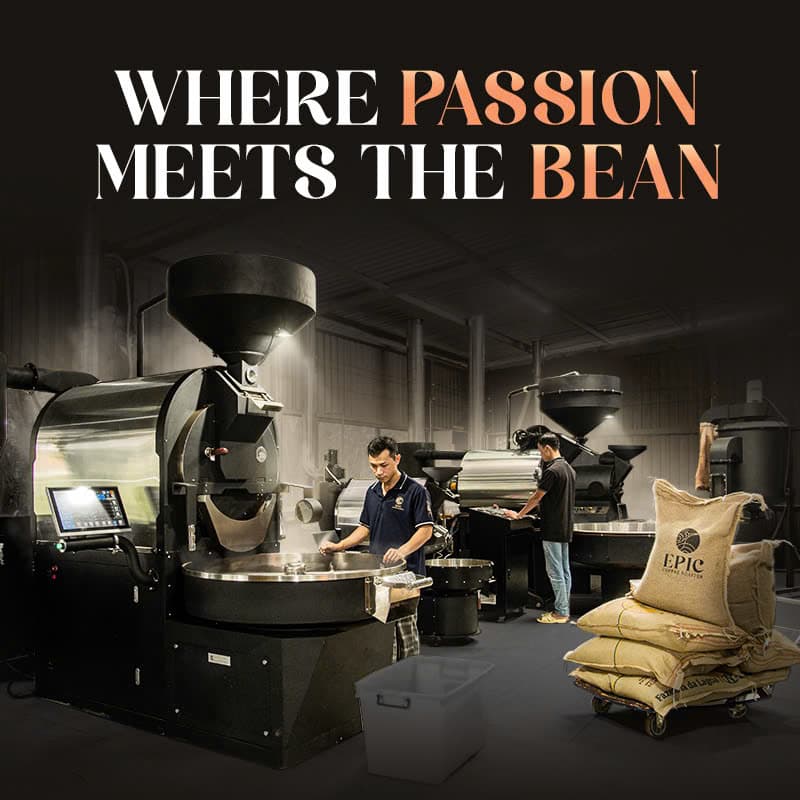
If you’re weighing whether to have a roaster develop a custom profile for your café, F&B chain, or brand, the real question is usually: what does working with a B2B roaster actually look like, step by step? From your first inquiry to the day your first full production batch ships, how many stages are there, how long does it take, and what should you prepare so you’re not going back and forth for weeks? This post walks through that process — sample roasting, cupping, and scaling up to full production orders — so you know what to expect from any B2B roaster, not just EPIC.

The 5-step process, from sample to full order
Whichever roaster you work with, a B2B roasting relationship usually moves through these five stages:
1. Initial brief. You describe the flavor you’re after (bold or light, more acidity or more body), your preferred bean (Arabica, Robusta, or a blend), your budget, and your expected monthly volume. This step matters most because it sets the direction for the sample roasts that follow.
2. Sample roasting. The roaster runs one or two different profiles in small batches — often just a few hundred grams to a kilogram or two per profile — enough for you to actually brew and taste at your own café, not just at the roastery.
3. Cupping — tasting together. This is where you and the roasting team evaluate the samples side by side and flag exactly what needs adjusting — less bitterness, more sweetness in the finish, less acidity — so the roaster can fine-tune the profile.
4. Locking the profile and placing a small trial order. Once you’ve approved a final sample through cupping, it’s worth placing one smaller trial order first — not your full target volume — to confirm the profile holds up when roasted at a larger batch size than the sample.
5. Moving to recurring full-scale production. Once quality has been consistent across a couple of runs, both sides agree on a recurring roasting schedule (weekly or monthly) so you always have coffee that matches your profile without restarting the whole process each time.
Why sample roasting and cupping shouldn’t be skipped
Cafés working with a B2B roaster for the first time often want to skip cupping to save time and jump straight to a large order based on a verbal description alone. The risk is that the actual roast profile can end up quite far from what you imagined — a roast one roaster calls “dark” can be noticeably different from the “dark” roast you’re used to elsewhere. A cupping session gets both sides speaking the same taste vocabulary before committing to a large order, so you avoid receiving a hundred kilos of coffee that misses the mark and having to send it back for a full re-roast.
Market context
According to the USDA Foreign Agricultural Service’s Coffee Annual report, published in May 2026, Vietnam’s domestic coffee consumption for the 2026/27 crop year is projected at roughly 5 million 60kg bags, up 2% from the prior year — a trend driven by a growing middle class, a rebound in tourism, and rising home brewing and specialty coffee habits (as summarized by Daily Coffee News in June 2026). As domestic demand grows, more cafés and F&B brands need a reliable, on-profile roast supply — which is exactly why more businesses are turning to on-demand B2B roasting rather than investing in their own roasting equipment from day one.
Why choose EPIC
- Profiles fine-tuned batch by batch, right after cupping. EPIC has roasted its own coffee in Saigon since 2014 on drum roasters, and after every tasting session with a client, the profile gets adjusted to match — not a single generic recipe applied to every partner.
- Resting time after roasting, before packing to order. This helps a full production batch stay as close as possible to the exact sample you approved during cupping, reducing the gap between what you tasted and what you actually receive.
- Experience with international partners. EPIC coffee has been exported to Russia and the Netherlands, so a structured sample-approve-scale process is nothing new for the roasting team.
- Running both a roastery and a café. With the roastery at 54/8 Ao Doi, Binh Hung Hoa, and the café at 49 Ngo Thoi Nhiem, District 3, HCMC, you can sit down and cup samples in person with the roasting team instead of coordinating everything over email.
As checked on 1 October 2026, EPIC’s B2B page lists a 5 kg monthly minimum, quote-only pricing, and free delivery for recurring monthly orders. Prepare your menu or brew method, expected volume, and delivery schedule to get a relevant proposal.
Want to try this sample-cupping-production process yourself? Reach out to EPIC’s B2B roasting team here to start the conversation.

We roast in-house at our own drum roastery in Sài Gòn — sourcing single-origin lots from a real, catalogued network and dialling profiles cup by cup for our own bar and for partners across Việt Nam.
@epiccoffeeroaster · Follow on InstagramSpecializing in